We are a team of 40 students, both undergraduate and graduate, from Pontificia Universidad Católica de Chile, competing for the second time in the RobotX Maritime Challenge.
Explore our site to discover more about our journey and team!
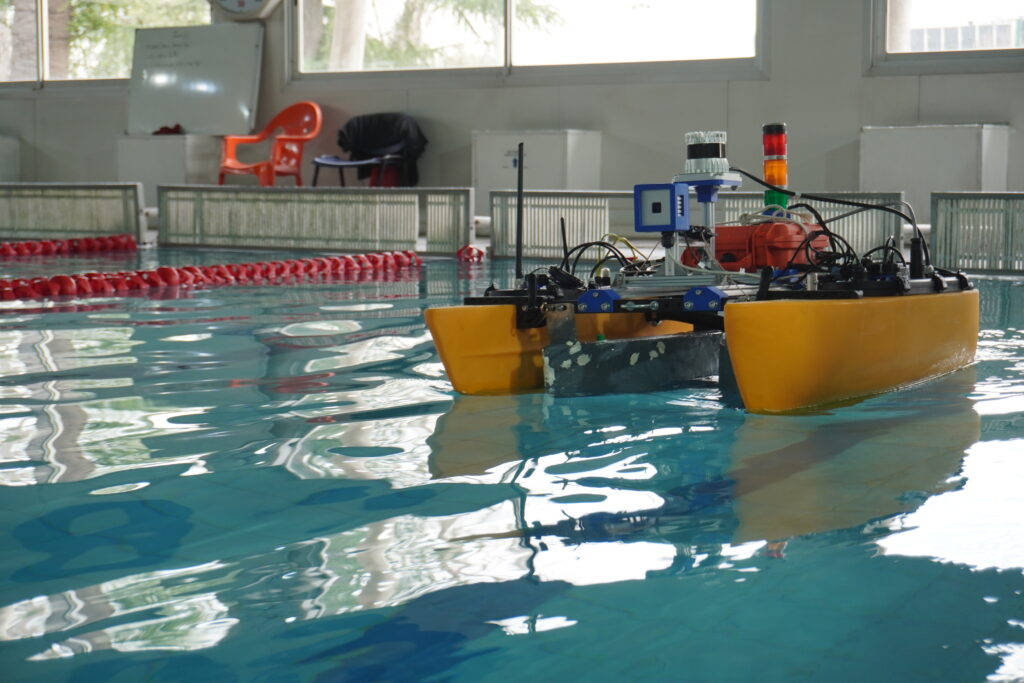
The USV is a modified BlueRobotics BlueBoat equipped with a custom fiberglass payload extension system that adds 20 kg of load capacity. It features a modular aluminum T-slot sensor tower housing an Ouster OS0 LiDAR, an OAK-1 PoE camera, a GNSS receiver, and a Pelican 1200 power distribution enclosure. Autonomous navigation relies on the Nav2 framework and the STVL plugin for dynamic obstacle avoidance. For active competition tasks, the vessel integrates a custom 2-DOF automated water cannon driven by stepper motors for precision targeting.
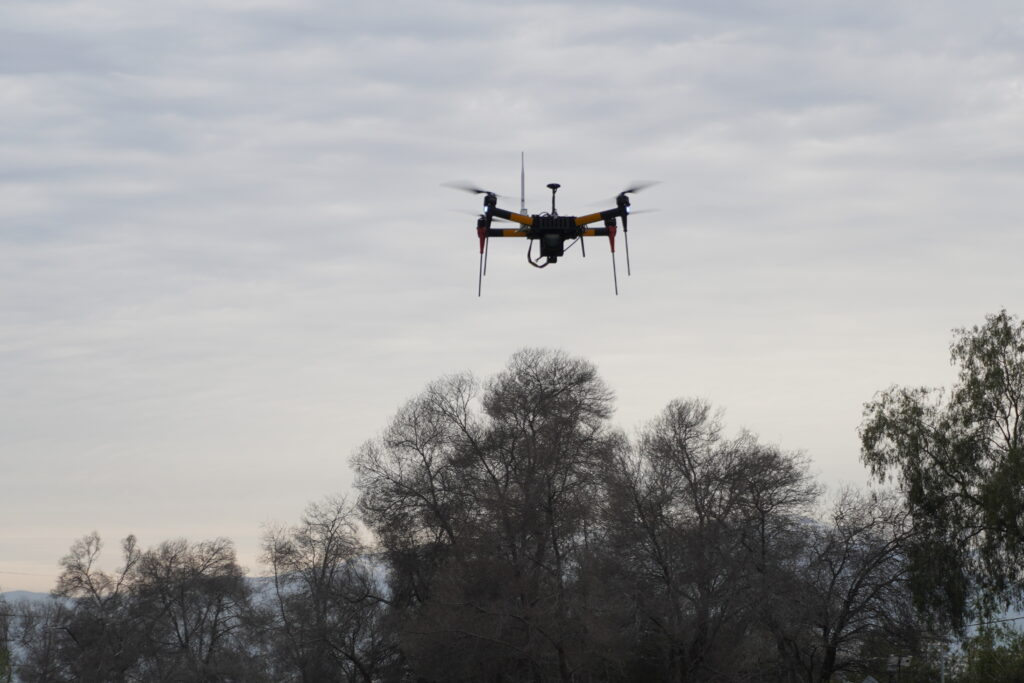
The UAV is built on a Hexoon EDU-650 V2 quadrotor frame, powered by a Pixhawk 6C flight controller and a LattePanda Delta 3 companion computer. Flight stabilization is handled by PX4 firmware, while a custom ROS 2 navigation stack executes high-level waypoint routing. For perception, it uses an OAK-1-W camera running YOLO algorithms to detect platforms. Its primary end-effector is a custom 3D-printed PETG magnetic pickup mechanism featuring a dual-electromagnet array and passive TPU damping to autonomously retrieve and deploy ferromagnetic payloads.
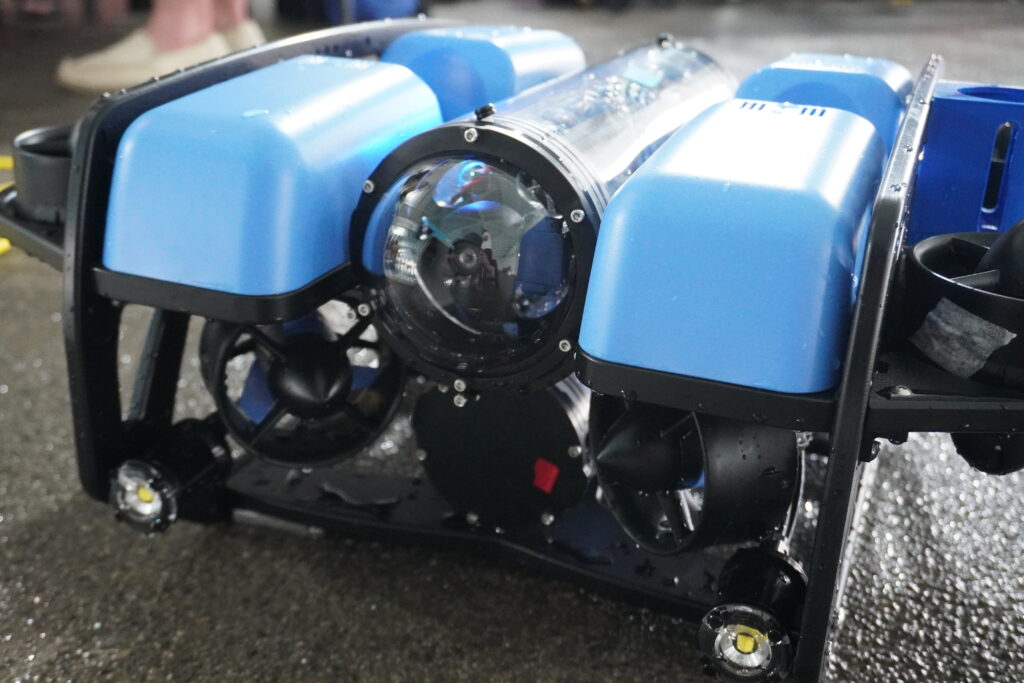
The UUV utilizes a BlueROV2 Heavy platform operating in a tethered configuration, which restricts its operational radius to 6 meters from the USV. Low-level hydrodynamic control and motor mixing are delegated entirely to the onboard BlueOS firmware. Because the UUV lacks drift-free internal odometry, its spatial localization relies heavily on the USV. It establishes its relative pose through a heterogeneous approach, a mounted acoustic pinger tracked by the USV’s hydrophone array, combined with a monocular camera that tracks an AprilTag mounted directly on the surface vessel.